Dryer vent installation and rerouting in Sarasota
Some vents are simply built wrong: too long, too many bends, or venting into an attic. Rerouting gives your dryer a shorter, straighter path outside, so it dries faster and stays safer.
- Rigid metal duct
- Built to Florida code limits
- New laundry rooms and remodels
When a dryer vent needs a new route
A dryer can only push air so far. Every foot of duct and every bend adds resistance. When a run is too long, lint settles faster and clothes take longer to dry, even right after a cleaning.
Rerouting replaces the old path with a shorter one. That might mean exiting through a closer wall, removing extra elbows, or replacing a flexible duct with smooth rigid metal.
New installations follow the same rules. If you are moving a laundry room, adding a dryer in a garage, or finishing a remodel, the vent should be planned before the walls close.
Signs a reroute is the right fix
- Slow drying right after cleaningThe run itself is the restriction.
- Long run with several bendsCommon in condos and upstairs laundry rooms.
- Vent ends in the attic or garageMoist, lint-filled air must exit outdoors.
- Flexible duct hidden in wallsConcealed runs need rigid metal duct.
- Moving or adding a dryerPlan the shortest path to an outside wall.
How rerouting a dryer vent works
Most residential reroutes take a single visit once the route is agreed.
Measure
The tech measures the current run, counts bends and checks the dryer maker’s limits.
Plan
You get a proposed route and a price before any work starts.
Install
Rigid metal duct is fitted, joints run in the airflow direction and are sealed with foil tape.
Terminate
A proper exterior hood with a damper is installed, never a screen that traps lint.
Test
Airflow is checked at the new hood, and the old path is capped or removed.
What affects the cost of a dryer vent reroute
Rerouting is quoted per job. The biggest factors are how far the new route travels and what it has to pass through.
| Factor | Why it matters |
|---|---|
| New route length | Shorter routes use less duct and labor. |
| Wall, roof or soffit exit | Roof and masonry penetrations take more time and sealing. |
| Finished surfaces | Drywall patching or stucco work adds cost. |
| Booster fan | Needed only when no compliant route exists. |
What is included
- Measurement of the existing run against code limits
- Rigid metal duct, sealed with foil tape
- New exterior hood with a backdraft damper
- Old duct capped or removed
- Airflow check when finished
Rerouting in Sarasota homes and condos
Upstairs laundry in newer builds
Lakewood Ranch and Palmer Ranch homes often vent up through the roof. A side-wall exit can cut the run in half.
Older block homes
Concrete block walls in older Sarasota neighborhoods make new wall exits harder. The route is planned to avoid structural work.
Condo rules
Many associations control exterior penetrations. Approval from the board may be needed before a new exit is cut.
Garage and lanai additions
Dryers moved to garages need a proper outdoor termination, not a vent into the garage.
Florida dryer vent length limit
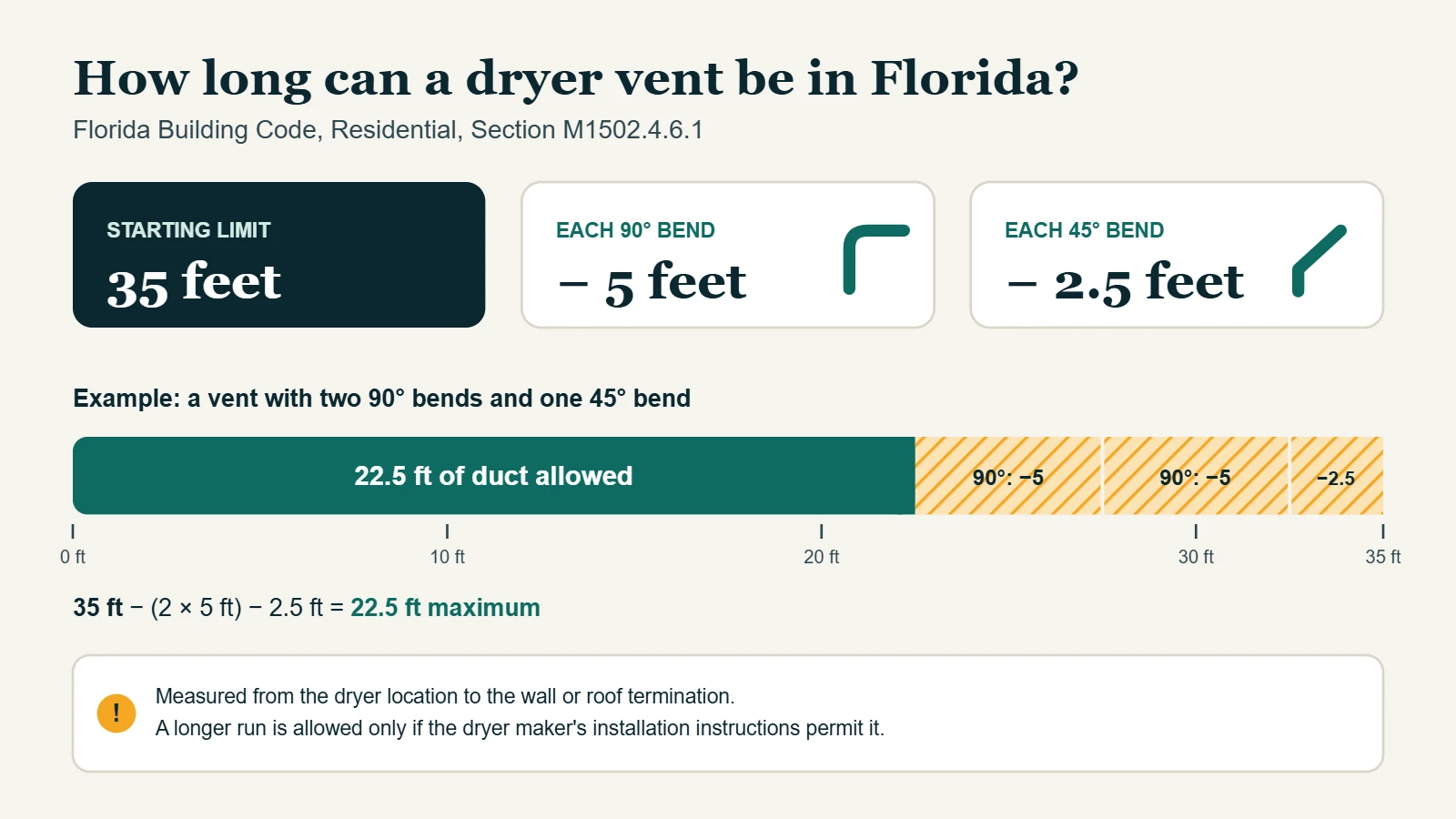
Under the Florida Building Code, Residential, a standard dryer exhaust duct can run up to 35 feet. Subtract 2.5 feet for each 45-degree bend and 5 feet for each 90-degree bend. A longer run is allowed only where the dryer manufacturer’s installation instructions permit it, or with a listed booster fan.
Reference: Florida Building Code, Residential, section M1502.4.5. Ducts must be rigid metal, at least 4 inches in diameter, and end outside the building.
Dryer vent installation and rerouting questions
How long can a dryer vent be in Florida?
A standard dryer vent can be up to 35 feet long. Subtract 2.5 feet for each 45-degree bend and 5 feet for each 90-degree bend. Longer runs are allowed only if the dryer maker permits it or a listed booster fan is used.
Can a dryer vent go into the attic?
No. A dryer vent must end outside the building. Venting into an attic, crawl space or garage puts moisture and lint where they can cause mold and fire risk.
Is flexible duct allowed for dryer vents?
Only for the short transition hose between the dryer and the wall. Ducts inside walls, floors and ceilings must be smooth rigid metal.
Do I need a booster fan?
Only if no route can meet the length limit. A listed dryer booster fan can move air through a longer run, but a shorter route is usually the better fix.
Where this service is available
Give your dryer a shorter path outside
Call now to talk through your vent and get a price before any work starts.